
We sat down with Ashley Denbo, our Director of Operations, to get her perspective on what separates well-run self storage facilities from the rest and what makes our approach different from other players in the space, including REITs.
Ashley oversees the site managers and operations managers who work directly with our facility owners across over 300 different locations, and she's seen firsthand what tends to go right, what tends to go wrong, and why.
We've pulled the highlights from our conversation below.
Q: What does being Director of Operations at White Label Storage actually involve?
A: "No two days are the same, but parts of every day can be the same and controlled if you plan well. Essentially, I support our site managers and operations managers. They're the ones on the ground with owners every day, figuring out what we need to do next.
A lot of what I do is stepping in to support them when they need it, or looking at the longer-term systems and processes and then thinking about how we enable our managers to do their job better, easier, and more efficiently."
Q: What are the biggest gaps you typically find when a new facility joins our portfolio?
A: "Almost always the finance side, either stale rates or unaddressed delinquency. We onboarded a facility recently where the prior management company hadn't adjusted current-tenant rates in over a year. That's real money left on the table.
On the delinquency side, the worst we've seen is a tenant more than 500 days past due. At that point, we know it's not going to resolve itself, so we act on it immediately."
Q: Why does delinquency seem to be such a common blind spot?
A: "A lot of it comes down to empathy. It's a person reaching out to an owner saying, 'I'll get you next month,' and then next month again. Most owners have the tools and know what the delinquency is, but when they've built a closer relationship with a tenant, it's easy to be convinced that next month will be different.
Then a year's gone by. That's actually one of our advantages: we operate at scale, so we can be a little less emotionally invested in that moment and act consistently, even when a tenant's told us seven months in a row that this time will be different."
Q: Does that same dynamic show up with rate increases on existing tenants?
A: "Absolutely, maybe even more so. Owners tend to give us more flexibility on new-tenant rates to stay competitive, but when it comes to existing tenants, it's often 'I know this person, let's not raise their rate, or only a little.'
What we believe is that we're not going to raise rates astronomically. We're not doubling anyone's rent overnight. And most people aren't going to pack up their entire unit and move it over $10 a month. Staying competitive with smaller, steady increases isn't usually what drives someone out the door."
Q: What has the biggest impact on whether a tenant stays or leaves?
A: "First, tenants need to feel good about the environment their belongings are in, and that comes back to on-site upkeep and making sure things look and feel secure.
The moment a tenant starts wondering if their stuff is safe, we're already on the back foot, and it's hard to walk that concern back once it's there. Second, how we respond when something goes wrong matters more than the fact that something went wrong.
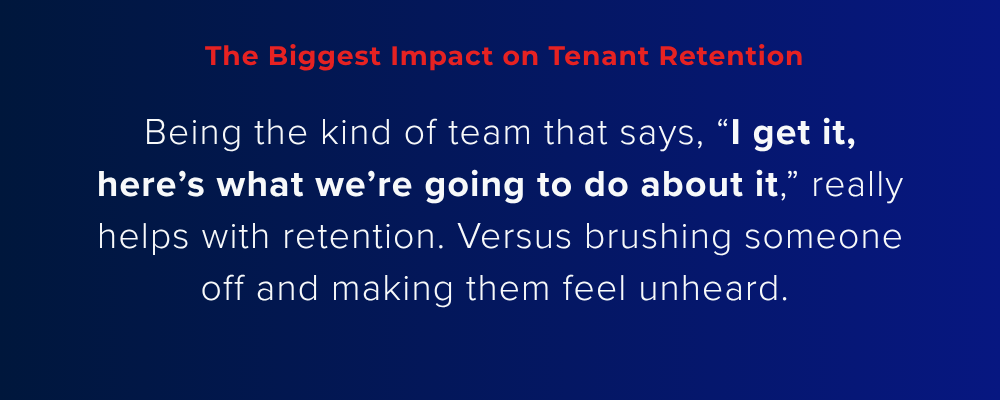
Gates go down, door codes glitch: tenants generally understand that happens. But being the kind of team that says, 'I get it, here's what we're going to do about it,' really helps with retention, versus brushing someone off and letting them feel unheard in that moment."
Q: How do you manage the people who are actually on the ground at a facility?
A: "We're only as good as our on-site staff, honestly. When there's someone there, whether it's daily staff or a field services contractor stopping by a few hours a week, they're carrying a lot that we simply can't handle remotely.
If they're not doing what they need to be doing, we're in a bad spot at that facility very quickly. So we try to treat it like a real partnership. Local knowledge is huge: they know the best vendors, they know what's coming up locally.
A college town is a great example: someone on-site can tell us school's back in session in September, so we should expect move-outs. That kind of context matters. A lot of our on-site staff are also more tenured. Some have been at a facility for five years before we ever came on board, and tapping into that historical knowledge is a real win for us.
So instead of just telling them what we're going to do, we're asking: here's what we're thinking and why, what are you seeing from your end? What do you know about this facility that we don't?"
Q: How has technology changed the way facilities get managed, especially remotely?
A: "It's huge. I talked to someone recently about their first self storage job, and it involved going into a room, pulling physical lease files, and digitizing them by hand. Going from that to tenants booking online is a massive shift.
Our revenue management tool is a great example. Before we rolled it out, reviewing rates meant checking competitor websites and updating numbers manually. It was a long project just to decide whether to change a single rate at one facility. Now it's about a three-minute run of the numbers, and the team makes the final call from there.
Our AI call agent has had a similar impact on the delinquency side. It's letting us make far more outreach calls than a team could realistically make on its own, which means tenants who are behind on payments get contacted more consistently instead of falling through the cracks.
Neither of these tools is replacing our team's judgment. Someone is still deciding what to do with the numbers RevMan produces, and someone's still deciding how to handle a delinquent account. What's changed is that the manual, repetitive part of the work, which used to consume hours, now takes minutes. I'm excited to keep pushing on that as our technology and AI capabilities keep improving."
Q: When an owner comes looking for management help, is there a pattern to what they need?
A: "I mentally group owners into three categories.
Most owners fall pretty close to one of those three, though plenty span the full range."
Q: How does knowing which of those three categories an owner falls into change how you work with them?
A: "It shapes the whole relationship from day one. When a new facility joins our portfolio, we have an entire team dedicated to bringing it live.
The technical implementation has to be right, because if we start on the back foot there, it takes us a while to catch up. That team is looking for whatever might catch us off guard and making sure everything's transitioned over cleanly.
Once that's done and we get the green light, my team steps in, and the first thing we're really figuring out is: why is this owner here? Why did they choose us? No one has the exact same answer.
Someone who just wants their monthly invoice and to be told if something's on fire is going to have a very different set of conversations with us than someone who wants weekly check-ins and to be walked through every decision.
Knowing that up front lets the team frame everything — the cadence of updates, what gets escalated, what doesn't — around what that specific owner actually wants out of the relationship."

Q: Do you think people underestimate what it takes to run a facility when they first get into it?
A: "Definitely. I don't know who first said self storage is 'set it and forget it' or that it just prints money for you, but a lot of people believed it. I believed it, honestly, before I got into the industry myself. Once you're in it, you realize there's so much more to running a facility well than just buying the building and hoping it works itself out."
Q: What's the biggest difference between working with us versus a REIT?
A: "We're here to work with you and for you, not force you into a fixed model. You keep your ownership and your brand because this isn't a hand-off, it's a partnership.
I've heard from so many owners, especially in the last six months, coming from REITs who felt like they had no control, like they were just a number and didn't really know what was going on.
It's genuinely a little shocking to them when our team walks them through our process and they realize that's not their only option. You get to retain ownership. You get to be as involved as you want to be.
Some owners tell us, 'I never want to hear from you, just send me my invoice and let me know if it burns down,’ and we can absolutely do that. Others we're meeting with weekly, walking through decisions together.
When you're coming from a REIT, or comparing us to one, I think that personal, flexible approach is the biggest difference people notice."
Q: What's the biggest misconception owners have about self storage management companies before they actually talk to you?
A: "That they'll have no decision-making power — that a management company is just going to do whatever it wants with their facility. That perception mostly comes from comparing us to REITs, where a lot of the time the REIT puts its own branding on the facility and effectively takes ownership of the experience.
We work differently. We're flexible by design. Yes, we have best practices, but there's room in almost all of it to work around what a specific owner actually wants."
Q: How do you personally define success for a facility, given that every owner's goals are a little different?
A: "A lot of it comes back to what the owner's goal was when they came to us in the first place: did they want their time back, did they want maximum occupancy, did they want more profitability without doing the work themselves?
Occupancy and revenue are always big measures for us, but we're also watching delinquency closely, because we don't want to be sitting at 100% occupancy with no one actually paying. So it's really about tracking progress against the owner's original goals while keeping an eye on the underlying health of the facility. Ideally, we're moving the needle on all of it at once."
Q: Is there a specific example that stands out?
A: "Tenant protection revenue is a big one. Our average capture rate across the portfolio is somewhere around 70–80%, and for a lot of owners coming from other management setups, that's revenue they didn't realize they were leaving on the table. A meaningful chunk of it wasn't making it back to them in the first place."
Q: If there's one thing owners should know about how we operate, what would it be?
A: "Two things, really. First, we're built to work for you, not fit you into a model. We have best practices, but there's flexibility in almost all of it. Second, when you bring us a question or a problem, our team's mindset is: how do we get to yes? It might not be exactly what you asked for, but we'll find something close to solve it. We're here to be a partner, not a blocker."
Want to see what we can do for your facility? Schedule a free demo with our team.